The Younger Dryas Impact Hypothesis at 20 Years (Water Woo: How Allen Whitt Became “Dr. Allen West”)
Water Woo: How Allen Whitt Became “Dr. Allen West”
In 1997, Allen Whitt of Water Surveys Company (Sedona Arizona) published the report “Groundwater Survey of the Tijeras Basin Area, Sandia Mountains, New Mexico.” It is the earliest publication I’ve been able to find by Whitt, who subsequently changed his name to Allen West, declared that he had a PhD, and emerged in 2006 as the mastermind of the Younger Dryas impact hypothesis (YDIH). If West’s extraordinary claims were true, it would overturn everything we know about my fields of research, including impact physics, cosmic airbursts, global catastrophes, paleoclimate, and planetary defense. It would also overthrow paradigms in archaeology, geology, paleontology, paleoecology, and other fields.
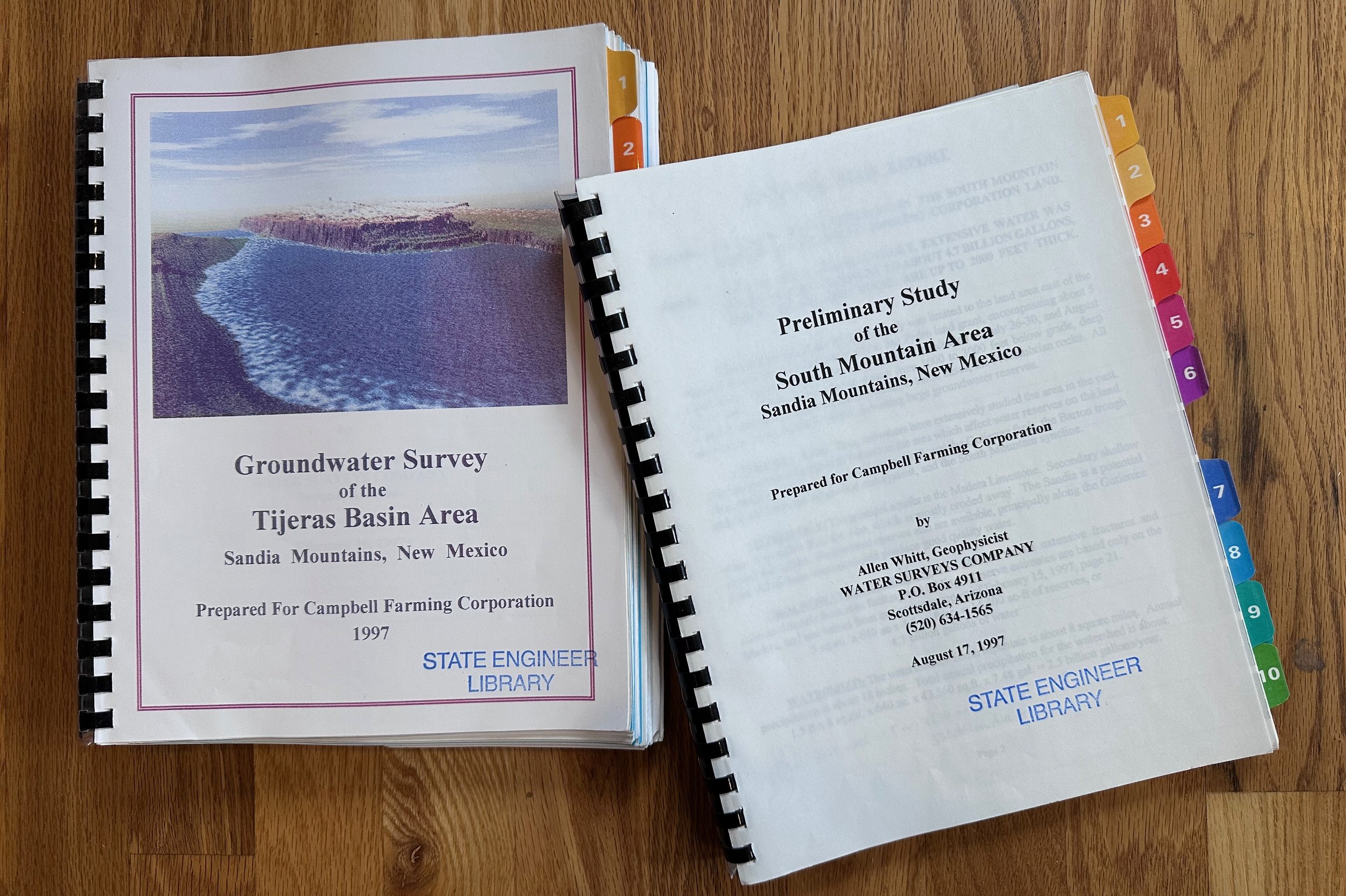
Allen Whitt represented himself as a geophysicist to his client in 1997 on his groundwater surveys in New Mexico
The YDIH is the pseudoscientific claim that the Earth experienced some sort of cosmic catastrophe about 12,900 years ago, leading to an abrupt climate change that wiped out the Clovis people in North America along with the mammoths and other large mammals they hunted. The specific details have changed with the telling and have evolved over time. The hypothesis seems to have converged on the notion of a shower of thousands of comet fragments that were all just the right size to explode in the Earth’s atmosphere without striking the ground or forming any impact craters.
The first publication of the hypothesis in its modern form was the book “Cycle of Cosmic Catastrophes” by Richard Firestone, Allen West, and Simon Warwick-Smith. The publisher, Bear & Company (now a division if Inner Traditions) was founded in Santa Fe, New Mexico, in 1980. According to its website, Bear & Company “specializes in books to broaden our perspective on the mysterious origins of humanity. Many experts recognizable from the Ancient Aliens television series have chosen to publish with Bear & Company.” According to Amazon, the first printing of the book was released on January 1, 2006. If true, today would be the 20th anniversary of the YDIH.
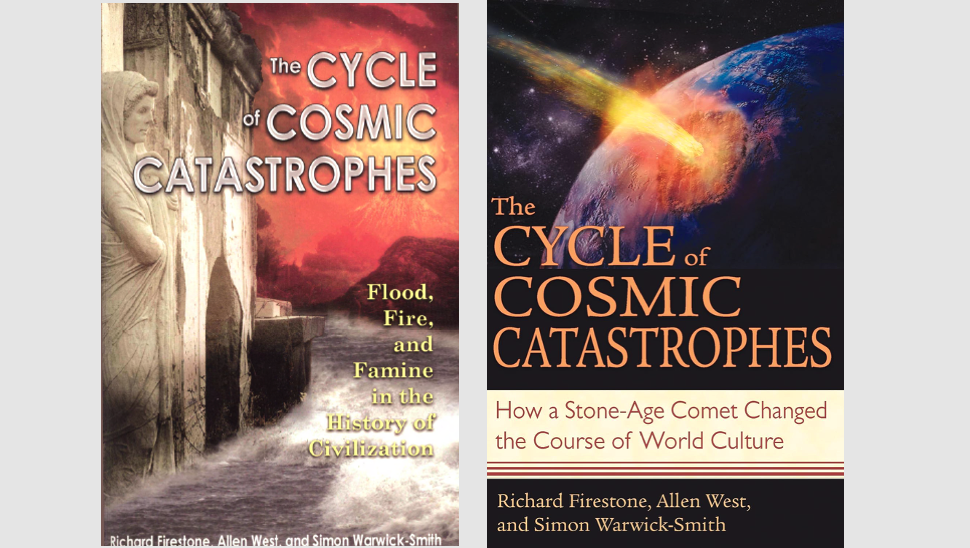
Left: First printing (January 1, 2006). Right: Second printing (June 5, 2006). Dates are according to Amazon.
The YDIH fires on all cylinders of pseudoscience, as expected from a publisher that specializes in mysterious origins and ancient aliens. The hypothesis superficially resembles science, but fails to adhere to the scientific method. The proponents now downplay the book and have gone to great lengths to create the appearance that their evidence for a comet catastrophe was rigorously peer reviewed. Their earliest papers, starting with Firestone et al (2007), went through a process that mimicked legitimate peer review, but were in fact edited by a hand-picked supporter who considered it to be his job was to get it published. Subsequent papers cited the early papers and claimed evidence that had never been established because raw data and methodology had not been revealed to the reviewers. The most detailed description of their data and methods appears in their 2006 book that never went through any kind of peer review. After 20 years the scientific community has still not been given the opportunity to evaluate much of the claimed evidence.
A second printing of the book was published on June 5, 2006, according to Amazon. It included some significant quiet edits that were not mentioned in an erratum or author notes. Among other things, it revealed that the authors had established a collaboration with members of the National Academy of Sciences, presumably James Kennett who became a coauthor, and Steven Stanley who became Kennett’s personal editor and handled the reviews of their papers for the Proceedings of the National Academy of Sciences (PNAS). It also appears to be the first published instance of West’s declaration that he has a PhD. The YDIH group’s first paper was submitted to PNAS on March 13, 2007, and communicated by Stanley that summer. The hypothesis was publicly announced with a splash by Nature’s well-known and highly regarded geosciences reporter, Rex Dalton, who covered their press conference at the American Geophysical Union Joint Assembly in Acapulco in May 2007 and published the story “Blast in the Past?”.
The YDIH team racked up a quick series of apparent spectacular successes that included the extraordinary on-camera discovery in 2008 of nanodiamonds in samples taken from an ice layer in Greenland and prepared by West for an award-winning episode of NOVA. But within a couple years, the hypothesis began to unravel. A second expedition by members of the YDIH team to Greenland in 2009 failed to report any additional impact evidence, or even a replication of the 2008 nanodiamond discovery. Also in 2009, a blue-ribbon team of independent experts published a PNAS paper, using the journal’s standard peer review, reporting that impact evidence found in samples collected and prepared by West for the YDIH team was not reproducible. In 2010, I reported at a conference in Santa Fe that the carbon spherules collected by the YDIH team from a plowed field in an industrial area beside an interstate highway and a rail line near Flint, Michigan had modern radiocarbon dates, consistent with wildfire and/or industrial contaminants.
The YDIH suffered its final credibility implosion within the scientific community in 2011, when the same reporter who had broken the story in 2007 wrote another story titled “Comet Theory Comes Crashing to Earth” with a shocking revelation.
Yet, the scientists who described the alleged impact in a hallowed U.S. scientific journal refuse to consider the critics’ evidence — insisting they are correct, even though no one can replicate their work: the hallmark of credibility in the scientific world.
The primary authors of the theory are an unusual mix: James Kennett, a virtual father of marine geology from the University of California, Santa Barbara; Richard Firestone, a physicist at Lawrence Berkeley Laboratory in California; and Allen West, an unknown academic from the mining industry who lives in Dewey, Ariz.
“We are under a lot of duress,” said Kennett. “It has been quite painful.” So much so, that team members call their critics’ work “biased,” “nonsense” and “screwed up.”
Such intransigence has been seen before in other cases of grand scientific claims. Sometimes those theories were based on data irregularities. Other times, the proponents succumbed to self-delusion. But typically, advocates become so invested in their ideas they can’t publicly acknowledge error.
A new look at the comet claim suggests all of these phenomena may be in play, apparently creating a peculiar bond of desperation as the theory came under increasing attack. Indeed, the team’s established scientists are so wedded to the theory they have opted to ignore the fact their colleague “Allen West” isn’t exactly who he says he is.
West is Allen Whitt — who, in 2002, was fined by California and convicted for masquerading as a state-licensed geologist when he charged small-town officials fat fees for water studies. After completing probation in 2003 in San Bernardino County, he began work on the comet theory, legally adopting his new name in 2006 as he promoted it in a popular book. Only when questioned by this reporter last year did his co-authors learn his original identity and legal history. Since then, they have not disclosed it to the scientific community.
As a consequence, PBS discontinued streaming of the NOVA episode which featured West as the heroic scientist who was able to single-handedly find evidence that had eluded others. According to the transcript (still available online):
In the past three years, West has dug into his retirement savings, shipping boxes of dirt to colleagues around the world, trying to solve the mystery. West has become his very own FedEx hub of Ice Age dirt.
Within a few years, PNAS closed the peer review loophole that had allowed the YDIH team to get their papers published in that journal, and they had to shop around for other journals. Even after their loss of access to PNAS, they were able to use their past papers to give their evidence from the 2006 book the appearance of legitimacy, and cited it as “peer reviewed evidence” in papers they submitted to other journals.
Ever since the 2011 revelation of the Whitt’s fraudulent groundwater surveys, scientists in relevant fields have overwhelmingly rejected the YDIH and any associated claims that are based on his original unreviewed evidence and unavailable data. The YDIH team, who now refer to their collaboration as the “Comet Research Group” have changed their focus from trying to convince scientists to a marketing campaign targeting a more lucrative audience: consumers of pseudoscience. This transition was consummated by the appearance of Allen West on Graham Hancock’s blockbuster pseudoarchaeology documentary series, Ancient Apocalypse. In a way, West has returned to his 1990s Sedona pseudoscience roots, before he changed his name from Allen Whitt and claimed to have an advanced degree. According to Dalton’s 2011 article.
West has no formal appointment at an academic institution. He has said he obtained a doctorate from a Bible college, but he won’t describe it further. Firestone said West has told him he has no scientific doctorate but is self-taught. West’s Arizona attorney refers to him in writing as: “A retired geophysicist who has had a long and distinguished career.”
In the early 1990s, a new-age business West was involved in Sedona, Ariz., failed, and his well-drilling company went bankrupt. Then he ran afoul of California law in small Mojave Desert towns in a scheme with two other men, with court records saying they collected fees up to $39,500 for questionable groundwater reports.
He originally was charged with two felonies for falsely representing himself as a state-licensed geologist but agreed to a no contest plea to a single misdemeanor of false advertising as part of plea bargain in which state records say he was fined $4,500. Two other men in the scam also were sanctioned.
There isn’t a lot of information on the internet about Allen Whitt in the 1990s, and how he made the transition from a purveyor of Sedona woo to a groundwater consultant before is jump to PhD scientist and pseudoscience celebrity. This will be the subject of my next post.